


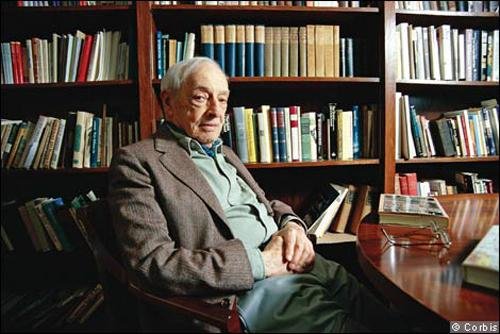
Saul Bellow (1915–2005) was one of the most influential American novelists of the twentieth century. Known for combining intellectual depth, humor, social observation, and intensely drawn characters, Bellow wrote about people struggling to find meaning and dignity in the confusion of modern life. His novels frequently explore identity, ambition, loneliness, family, friendship, mortality, and the tension between intellectual ideals and everyday existence.
Early Life
Bellow was born Solomon Bellows on June 10, 1915, in Lachine, Quebec, near Montreal. His parents, Abraham and Lescha Bellows, were Jewish immigrants from Russia who had left Europe only a few years before his birth. He was the youngest of four children.
When Bellow was nine, his family moved to Chicago, the city that would become enormously important to both his life and fiction. Chicago appears throughout his writing not simply as a setting but almost as a character itself—a sprawling, energetic, sometimes harsh city filled with immigrants, businessmen, intellectuals, criminals, dreamers, and people attempting to reinvent themselves.
Bellow grew up speaking several languages and was exposed to both Jewish religious traditions and American popular culture. As a child he became seriously ill and spent considerable time in the hospital. During his recovery, reading became especially important to him.
His mother hoped he might become a rabbi or concert violinist. Bellow instead became increasingly attracted to literature.
Education and the Beginning of a Literary Career
Bellow attended the University of Chicago before transferring to Northwestern University, where he graduated in 1937 with a degree in anthropology and sociology. His academic background would influence his fiction. Bellow was fascinated by the ways people behave within families, communities, institutions, and societies.
He initially considered graduate study in anthropology but eventually turned toward writing.
During World War II, Bellow served in the U.S. Merchant Marine. His experiences during this period contributed to his early fiction.
His first novel, Dangling Man, appeared in 1944. Written largely in diary form, it concerns a young Chicago man waiting to be drafted into the military. Already present were themes Bellow would revisit throughout his career: isolation, uncertainty, personal responsibility, and the difficulty of maintaining an individual identity within modern society.
His second novel, The Victim, followed in 1947.
Finding His Literary Voice
Bellow’s major breakthrough came with The Adventures of Augie March in 1953.
The novel represented a dramatic change in his writing. Instead of the restrained style of his earlier books, Bellow adopted a vigorous, expansive American voice. Its famous protagonist travels through an extraordinary assortment of occupations, relationships, and adventures while trying to determine what sort of person he wants to become.
The book won the National Book Award for Fiction and established Bellow as a major American novelist.
Bellow followed it with Seize the Day in 1956, a much shorter and more concentrated work. It tells the story of Tommy Wilhelm, a struggling middle-aged man whose professional failures, financial problems, difficult relationship with his father, and desperate search for emotional connection converge during a single day.
The novella became one of Bellow’s most widely read works.
Henderson the Rain King and Herzog
In Henderson the Rain King (1959), Bellow created Eugene Henderson, a wealthy but deeply dissatisfied American who travels to Africa searching for something that will give meaning to his life. The novel combines comedy, philosophy, adventure, and spiritual searching.
Then came one of Bellow’s greatest successes.
Herzog, published in 1964, centers on Moses Herzog, an intellectual undergoing emotional and personal collapse after the failure of his marriage. Herzog compulsively composes letters—many of which he never sends—to friends, enemies, philosophers, politicians, religious figures, and even the dead.
Through those imaginary letters, Bellow explores one of his central concerns: Can intellectual knowledge actually teach someone how to live?
Herzog became a bestseller and earned Bellow another National Book Award.
Mr. Sammler’s Planet
Bellow continued exploring the moral uncertainties of modern society in Mr. Sammler’s Planet (1970).
Its central character, Artur Sammler, is an elderly Holocaust survivor living in New York. Observing the cultural upheavals surrounding him, Sammler reflects on civilization, morality, violence, freedom, and human responsibility.
The novel earned Bellow his third National Book Award for Fiction, an extraordinary achievement.
Humboldt’s Gift
One of Bellow’s most important later novels was Humboldt’s Gift, published in 1975.
The book follows successful writer Charlie Citrine and his memories of his friend and mentor, the brilliant but self-destructive poet Von Humboldt Fleisher. Humboldt is partly inspired by Bellow’s real-life friend, the poet Delmore Schwartz.
Through their relationship, Bellow examines the conflict between art and money, intellectual ambition and celebrity, friendship and rivalry, success and failure.
Charlie achieves the recognition Humboldt desperately wanted, yet material success does not necessarily provide the wisdom or fulfillment Charlie expected.
The novel mixes serious philosophical questions with Bellow’s characteristic humor. Gangsters, writers, academics, businessmen, former wives, lawyers, and intellectuals all collide within Charlie’s increasingly complicated existence.
Humboldt’s Gift won the 1976 Pulitzer Prize for Fiction.
The Nobel Prize
That same year marked the high point of Bellow’s international recognition.
In 1976, he received the Nobel Prize in Literature. The Swedish Academy praised the combination of human understanding and cultural analysis found in his work.
By then, Bellow had become one of the central figures in postwar American literature.
His fiction was unusual because it could be intensely intellectual without abandoning storytelling. His characters might contemplate Nietzsche, religion, death, history, or metaphysics—and a few pages later find themselves arguing about money, marriage, sex, apartments, careers, or family problems.
For Bellow, those worlds were inseparable.
Later Life and Writing
Bellow continued writing well into old age. His later books included The Dean’s December (1982), More Die of Heartbreak (1987), A Theft (1989), The Bellarosa Connection (1989), The Actual (1997), and Ravelstein (2000).
Ravelstein, published when Bellow was in his eighties, was inspired partly by his friendship with political philosopher Allan Bloom, author of The Closing of the American Mind. The novel examines friendship, mortality, intellectual life, love, and the responsibility of remembering someone after death.
Bellow also taught literature and writing for many years, most notably at the University of Chicago, influencing generations of students and younger writers.
Personal Life
Bellow’s private life was complicated and frequently found its way into his fiction.
He was married five times and had four children. His marriages, divorces, friendships, rivalries, financial disputes, and relationships with other intellectuals supplied him with abundant fictional material.
This autobiographical quality occasionally caused controversy because people who knew Bellow sometimes recognized versions of themselves in his characters.
Yet Bellow rarely produced simple fictional portraits. He transformed experiences and personalities into characters who served the larger philosophical and emotional concerns of his novels.
Death and Legacy
Saul Bellow died on April 5, 2005, at his home in Brookline, Massachusetts. He was 89.
His literary reputation rests particularly on The Adventures of Augie March, Seize the Day, Henderson the Rain King, Herzog, Mr. Sammler’s Planet, Humboldt’s Gift, and Ravelstein.
What makes Bellow distinctive is his fascination with the inner life of intelligent but deeply imperfect people. His characters often believe that if they think hard enough, read enough, travel far enough, earn enough money, or fall in love with the right person, they will finally understand themselves.
Usually, they discover that life refuses to become that orderly.
That tension gives Bellow’s work much of its power. His novels ask enormous questions—What makes a meaningful life? What do we owe other people? Can culture make us better? What survives after success, failure, love, and death?—while keeping those questions grounded in recognizable human lives.
That is especially true of Humboldt’s Gift. Beneath its comedy and intellectual conversations lies a deeply personal story about friendship, regret, artistic ambition, and what one person leaves behind in another.
For a reader encountering Bellow today, that combination of big ideas and messy humanity remains one of the strongest reasons his work continues to matter.